// I've always found the idea of sandboxes fascinating, so I tried to figure out how it's built. After some reading, I ended up building my own sandbox system, [Minival](https://seccomp-eval.herokuapp.com/).
//
-// What you are reading right now is the commented source for this sandbox, which also serve as a tutorial of sorts about sandboxing.
+// What you are reading right now is the commented source for this sandbox, which also serve as a tutorial of sorts about sandboxing.
//
// You shouldn't need to have more than some passing knowledge of C and UNIX syscalls to understand this tutorial, so let's jump right in!
//
// Ptrace seems fine – I heard that that's what [eval.in](https://eval.in) uses - but it would be a little annoying to implement in Python. It also has a non-negligible performance hit.
-// Seccomp seemed a bit better at the time, even though it didn't really have a good Python interface, which caused me to end up writing everything in C.
+// Seccomp seemed a bit better at the time, even though it didn't really have a good Python interface, so I ended up writing everything in C.
+//
+// ## How minival works
+//
+// Minival is a pretty straightforward Python webapp – people type code into a form, select a runtime then submit it. Behind the scenes, the Python app spawns a helper process that does all the sandboxing setup, and then runs the untrusted code:
+//
+// 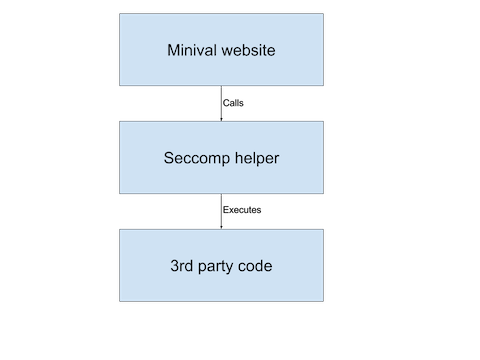
+// The helper will setup some helpful limits and then call execve(2) to run a Python or PERL process. Once the limits are set, the 3rd-party code is effectively restricted to the whitelist of syscalls we defined.
-//
+
+// Let's start by including a bunch of UNIX includes
#include <stdio.h>
#include <stdlib.h>
int main(int argc, char **argv) {
if (argc != 3) {
- printf("usage: seccompctl <python|perl|ruby> source_file\n");
+ printf("usage: seccompctl <python|perl> source_file\n");
exit(-1);
}
- // First, setup an rlimit limit.
+ // First, we have to setup some CPU and memory limits. We use the setrlimit(2) syscall
+ // for that. We have to do this before setting up the sandbox because we do not want
+ // people to be able to change them after that the sandbox is running.
+
+ // Limit the maximum CPU time of the process to 10 seconds.
struct rlimit rl;
rl.rlim_cur = 10;
- setrlimit (RLIMIT_CPU, &rl);
+ setrlimit(RLIMIT_CPU, &rl);
+
+ // Let's also limit stack and heap usage to 16MB.
+ getrlimit(RLIMIT_STACK, &rl);
- // Init the filter
+ rl.rlim_max = 16*1024*1024;
+ setrlimit(RLIMIT_STACK, &rl);
+ setrlimit(RLIMIT_DATA, &rl);
+
+ // Setup seccomp. SCMP_ACT_KILL tells the kernel to kill processes when they make a
+ // forbidden syscall.
scmp_filter_ctx ctx;
- ctx = seccomp_init(SCMP_ACT_KILL); // default action: kill
+ ctx = seccomp_init(SCMP_ACT_KILL);
- // setup basic whitelist
+ // Let's whitelist a bunch of syscalls. We do this by calling
+ // `seccomp_rule_add` with some parameters to match syscalls.
+ //
+ // Note that I got this list mostly by trial and error; I had to run strace
+ // on the python interpreter to see which syscalls it was making.
seccomp_rule_add(ctx, SCMP_ACT_ALLOW, SCMP_SYS(access), 0);
seccomp_rule_add(ctx, SCMP_ACT_ALLOW, SCMP_SYS(arch_prctl), 0);
seccomp_rule_add(ctx, SCMP_ACT_ALLOW, SCMP_SYS(brk), 0);
+ seccomp_rule_add(ctx, SCMP_ACT_ALLOW, SCMP_SYS(clock_gettime), 0);
seccomp_rule_add(ctx, SCMP_ACT_ALLOW, SCMP_SYS(close), 0);
seccomp_rule_add(ctx, SCMP_ACT_ALLOW, SCMP_SYS(connect), 0);
seccomp_rule_add(ctx, SCMP_ACT_ALLOW, SCMP_SYS(execve), 0);
seccomp_rule_add(ctx, SCMP_ACT_ALLOW, SCMP_SYS(geteuid), 0);
seccomp_rule_add(ctx, SCMP_ACT_ALLOW, SCMP_SYS(getgid), 0);
seccomp_rule_add(ctx, SCMP_ACT_ALLOW, SCMP_SYS(getpid), 0);
+ seccomp_rule_add(ctx, SCMP_ACT_ALLOW, SCMP_SYS(getrandom), 0);
seccomp_rule_add(ctx, SCMP_ACT_ALLOW, SCMP_SYS(getrlimit), 0);
seccomp_rule_add(ctx, SCMP_ACT_ALLOW, SCMP_SYS(getuid), 0);
seccomp_rule_add(ctx, SCMP_ACT_ALLOW, SCMP_SYS(ioctl), 0);
seccomp_rule_add(ctx, SCMP_ACT_ALLOW, SCMP_SYS(rt_sigaction), 0);
seccomp_rule_add(ctx, SCMP_ACT_ALLOW, SCMP_SYS(rt_sigprocmask), 0);
seccomp_rule_add(ctx, SCMP_ACT_ALLOW, SCMP_SYS(rt_sigreturn), 0);
+ seccomp_rule_add(ctx, SCMP_ACT_ALLOW, SCMP_SYS(sched_getaffinity), 0);
seccomp_rule_add(ctx, SCMP_ACT_ALLOW, SCMP_SYS(set_robust_list), 0);
seccomp_rule_add(ctx, SCMP_ACT_ALLOW, SCMP_SYS(set_tid_address), 0);
- seccomp_rule_add(ctx, SCMP_ACT_ALLOW, SCMP_SYS(sched_getaffinity), 0);
- seccomp_rule_add(ctx, SCMP_ACT_ALLOW, SCMP_SYS(clock_gettime), 0);
- seccomp_rule_add(ctx, SCMP_ACT_ALLOW, SCMP_SYS(getrandom), 0);
seccomp_rule_add(ctx, SCMP_ACT_ALLOW, SCMP_SYS(stat), 0);
seccomp_rule_add(ctx, SCMP_ACT_ALLOW, SCMP_SYS(sysinfo), 0);
- // Don't let people open files in read-write mode.
+ // Astute readers may have noted that we haven't whitelisted the open(2)
+ // syscall yet. This is because we want to prevent people from creating files.
+ // To do that, we'll only whitelist and handful of parameters: O_RDONLY, O_CLOEXEC,
+ // O_NONBLOCK, O_DIRECTORY. Because the parameters are ORed together, we have to
+ // do this on three separate lines.
seccomp_rule_add(ctx, SCMP_ACT_ALLOW, SCMP_SYS(open), 1,
SCMP_A1(SCMP_CMP_EQ, O_RDONLY));
seccomp_rule_add(ctx, SCMP_ACT_ALLOW, SCMP_SYS(open), 1,
SCMP_A1(SCMP_CMP_EQ, O_RDONLY|O_NONBLOCK|O_DIRECTORY|O_CLOEXEC));
- // Disable sockets that aren't local
+ // Python also tries to make so local socket connections when starting –
+ // so let's open up sockets but only if they're local.
seccomp_rule_add(ctx, SCMP_ACT_ALLOW, SCMP_SYS(socket), 1,
SCMP_A0(SCMP_CMP_EQ, AF_LOCAL));
- // This is a one-off rule for perl
+ // Another one-off rule – PERL needs to use fnctl for some reason, so let's
+ // open it up.
seccomp_rule_add(ctx, SCMP_ACT_ALLOW, SCMP_SYS(fcntl), 1,
SCMP_A2(SCMP_CMP_EQ, FD_CLOEXEC));
-
- // Limit writes to the stdin, stdout and stderr.
+ // We also need to prevent people from writing to any files on the file system
+ // besides stdin, stdout and stderr. To do that, we let people write to
+ // file descriptors 0, 1 and 2, since on UNIX they're the default values for stdin, stdout and sterr.
for (int i = 0; i < 3; i++) {
seccomp_rule_add(ctx, SCMP_ACT_ALLOW, SCMP_SYS(write), 1,
SCMP_A0(SCMP_CMP_EQ, i));
}
- // build and load the filter
- seccomp_load(ctx);
+ // Now, let's load the filter!
+ if (seccomp_load(ctx) != 0) {
+ printf("Couldn't load seccomp filter! Exiting!");
+ exit(-1);
+ }
+ // We can now let the Python or PERL interpreters run the program safely!
if (strncmp(argv[1], "python", 16) == 0) {
char *args[] = { "/usr/bin/python", argv[2], 0};
execve(args[0], (char **const) &args, NULL);
 Repositories / minival.git / commitdiff